

Effective Marketing Strategies
for Mobile Apps
posted: November 20, 2025Why Most Mobile Apps Struggle With Visibility and Retention?
Most mobile apps don’t fail because the idea is bad. They fail because nobody sticks around long enough to notice them.
A team can build a solid product with a skilled mobile app development company, but that alone doesn’t guarantee installs or engagement. Once the app goes live, it enters a crowded space where users are already scrolling past hundreds of options without thinking twice.
The numbers make that behavior hard to ignore. Research shows nearly 25% of apps are opened only once after installation. That’s not a product problem in most cases. It’s a visibility and retention problem.
This is where mobile app marketing starts to matter in a very practical way. Not as a launch activity, but as an ongoing system that keeps the app in front of users long enough to become relevant.
And that’s also why app marketing strategies have shifted. It’s no longer about just publishing your app on app stores. It’s paid campaigns, content discovery, and retention efforts working together so the app doesn’t disappear after day one.
In simple terms, mobile app promotion today is less about getting attention once and more about staying visible long enough for people to actually care.
Strategy 1: Understand Real User Demand Before You Build Anything
Most apps don’t fail after launch. They fail much earlier, when they’re built around assumptions instead of validating the mobile app idea. By the time mobile app marketing starts, the positioning is already slightly off.
This strategy is about correcting that gap before anything gets locked in.
1.1 Competitor Review Mining for Real Pain Points
App reviews are one of the clearest signals in mobile app promotion, but most teams barely use them beyond surface reading.
Focus on patterns, not opinions:
- Repeated complaints across competing apps
- Features users expected but didn’t get
- Friction points in onboarding or daily use
The useful part isn’t what people like or dislike individually, it’s what keeps showing up. That repetition points directly to unmet expectations in the market.
Strong app marketing strategies turn those gaps into positioning angles. For example, “too complicated” becomes a message about simplicity. “Too many steps” becomes a frictionless experience in positioning.
1.2 Intent-Based Market Research (Not Feature Research)
Most early research starts with features. Better mobile app marketing starts with search behavior.
Instead of guessing what users want, look at how they search:
- App Store and Google Play search patterns
- Real phrases users type when looking for solutions
- High-intent vs casual curiosity queries
There’s usually a clear mismatch between internal product language and user search language. Fixing that mismatch early improves everything later, from ASO to paid campaigns.
The core shift is simple: don’t map features to ideas, map user intent to outcomes. Once that clicks, mobile app promotion becomes far more predictable.
Strategy 2: Build Keyword Intelligence for App Store Visibility (ASO Core)
If Strategy 1 is about understanding demand, this one is about making sure the app actually shows up when that demand turns into a search. In mobile app marketing, visibility inside app stores is not optional anymore. It’s often the first and most consistent acquisition channel.
This is where app marketing strategies start getting measurable.
2.1 Functional vs Problem vs Long-Tail Keywords
Most App Store Optimization failures come from treating keywords like a list instead of a structure. Strong mobile app promotion starts by separating intent into layers:
- Functional keywords — what the app actually does (e.g., “budget tracker”, “fitness planner”)
- Problem-based keywords — what users are trying to fix (e.g., “save money easily”, “lose weight at home”)
- Long-tail queries — specific, high-intent searches that convert better (e.g., “budget app for students with no ads”)
Each layer serves a different purpose. Functional keywords bring reach, problem-based keywords improve relevance, and long-tail keywords usually drive higher-quality installs.
The balance between them is what determines whether mobile app marketing produces volume or just noise.
2.2 Competitor Keyword Gap Analysis
Most apps compete for the same obvious keywords. That’s where saturation happens.
A more effective app marketing strategy approach is identifying what competitors are not targeting properly:
- Keywords appearing in user reviews but missing from listings
- Search terms competitors rank poorly for despite relevance
- Niche queries with lower competition but strong intent
This is less about copying competitors and more about finding weak spots in their visibility.
In many cases, the fastest wins in mobile app promotion come from these overlooked search pockets rather than high-volume competitive terms.
2.3 App Store Language Optimization
Once keyword intelligence is clear, the next step is how it’s applied inside the store listing. This is where a lot of apps either improve conversion or lose it.
Key focus areas:
- Title and subtitle aligned with both functionality and intent
- Description written for clarity first, keywords second
- Natural keyword placement instead of forced repetition
- Review the language used to refine how the app is described
The goal is simple: make the listing feel like it was written in the same language users already use when searching.
When done properly, this doesn’t just improve ranking. It directly improves conversion from search to install, which is the real goal of mobile app marketing.
Strategy 3: Pre-Launch Mobile App Promotion That Builds Demand Early
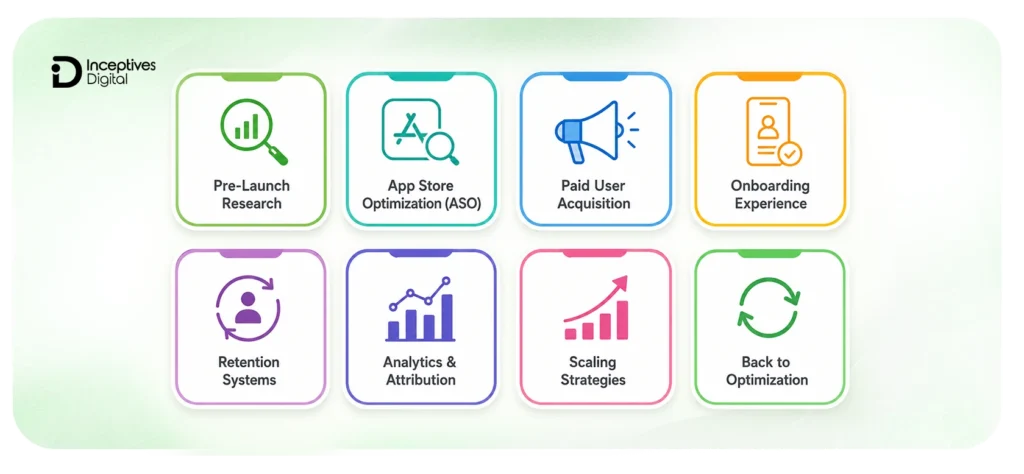
This is where mobile app marketing starts before the product even hits the App Store. The goal isn’t to install yet. It’s attention, curiosity, and proof that people actually care.
Most apps skip this and jump straight into launch mode, then end up paying more later just to recreate early demand.
3.1 Landing Pages That Capture Early Interest
A minimum viable product is less about explaining the product and more about testing if anyone wants it in the first place.
Strong mobile app promotion at this stage usually keeps things simple:
- One clear value statement instead of multiple features
- A focused message that explains the problem being solved
- Email capture to collect early interest
The key is restraint. If the page tries to do too much, users leave without taking action. If it’s too vague, they don’t understand why they should care.
This step often gives the first real signal in app marketing strategies about whether positioning is strong enough or needs adjustment.
3.2 Waitlists and Beta Community Building
Once interest starts forming, the next step is controlling it instead of letting it scatter.
Effective mobile app marketing uses waitlists and beta groups to create structure around early demand:
- Waitlists turn curiosity into commitment
- Beta users provide real feedback before launch
- Early adopters often become the first advocates
What matters here is not scale but signal quality. A smaller, engaged group is far more valuable than a large passive audience at this stage.
This phase also reduces guesswork later because real usage feedback starts shaping product decisions before full rollout.
3.3 Social Teaser Campaigns Before Launch
This is where messaging starts getting tested in real environments.
Instead of polished ads, strong mobile app promotion here focuses on lightweight experiments:
- Short-form videos to test hooks and angles
- Multiple variations of the same idea to see what gets attention
- Early validation of messaging before spending on paid campaigns
What works on social rarely matches what teams assume will work internally. This stage helps correct that gap early.
In many app marketing strategies, this is where the first signs of product-market messaging alignment appear. If people stop scrolling, engage, or sign up, you know you’re close.
Strategy 4: App Store Optimization That Drives Organic Installs
Once the app is live, visibility inside the store becomes one of the most stable channels in mobile app marketing. Paid ads can fluctuate, but search-driven installs keep coming when ASO is done right.
This strategy focuses on turning store listings into conversion assets, not just information pages.
4.1 Visual Conversion Strategy
Most users don’t read app descriptions first. They scan visuals, then decide in a few seconds whether to continue or leave. That’s why visuals quietly carry a big part of mobile app promotion success.
Key elements that matter:
- Icon design psychology — simple shapes, clear contrast, and instant recognition matter more than complexity
- Screenshot storytelling — showing a flow like problem → solution works better than random feature slides
- The first screenshot often decides whether users keep scrolling or bounce
In strong app marketing strategies, visuals are treated like ad creatives. They are not decorations; they are conversion triggers.
4.2 Ratings and Review Growth Systems
Reviews are not just social proof. They directly influence ranking and conversion inside app stores.
In mobile app marketing, the early-stage review strategy usually focuses on:
- Asking for feedback at the right moment (after a positive action, not immediately after install)
- Encouraging real users, not fake or forced reviews
- Making it easy for satisfied users to respond quickly
Two things matter most here:
- Early review velocity helps visibility in search rankings
- Sentiment quality impacts conversion rate once users land on the page
Even a well-ranked app can lose installs if the review tone signals confusion or frustration.
4.3 Continuous ASO Iteration
ASO is not a one-time setup. It behaves more like a feedback loop inside mobile app promotion, where data keeps refining visibility.
Ongoing optimization usually includes:
- A/B testing icons, screenshots, and preview videos
- Updating keywords based on seasonal or trending search behavior
- Monitoring competitor listing changes and reacting to gaps
The strongest app marketing strategies treat ASO as a living system. Small changes in visuals or keywords can shift conversion rates significantly over time, especially when combined with steady traffic from other channels.
Strategy 5: Paid Mobile App Marketing That Scales Installs
Paid acquisition is where mobile app marketing turns from experimentation into scaling. But it’s also where budgets get burned quickly if intent, creatives, and tracking aren’t aligned.
The goal here isn’t just installs. It’s finding channels that can consistently bring users who actually stay.
5.1 Apple Search Ads for High-Intent Users
Apple Search Ads sits closest to user intent because people are actively searching when they see your ad.
In strong app marketing strategies, this channel is used for precision, not awareness:
- Keyword-driven installs based on exact search terms
- High conversion rates due to strong intent
- Competitive bidding environment for popular categories
The challenge is the mobile app marketing cost. High-intent keywords can get expensive quickly, which makes keyword selection and negative keyword control a critical part of mobile app promotion.
5.2 Google App Campaigns for Broad Reach
Google App Campaigns work differently. Instead of manual targeting, everything is automated across Search, YouTube, Play Store, and Display.
In mobile app marketing, this channel is often used for scale:
- Automated audience targeting based on behavior signals
- Broad exposure across Google’s ecosystem
- Faster reach compared to manual campaign setups
The limitation is control. Once the system optimizes, you have less visibility into granular performance, which means creative quality and conversion tracking become the real levers for improvement.
5.3 Social Media App Promotion (TikTok, Meta, Reels)
This is where attention decides performance more than targeting.
Modern mobile app promotion on social platforms is heavily creative-driven:
- TikTok and Reels work best for discovery-first content
- Meta Ads still perform well for structured audience targeting
- Short-form videos often outperform static ads
What matters most is how fast an ad captures attention. Users scroll quickly, so the first 2–3 seconds decide everything.
Another factor is creative fatigue. Even strong ads lose performance over time, which makes continuous mobile app testing part of any serious app marketing strategy setup.
5.4 Influencer-Led Mobile App Promotion
Influencers bridge the gap between ads and trust, especially in the U.S. market, where users respond strongly to real demonstrations.
Effective mobile app marketing here usually includes:
- Micro influencers for niche, high-trust audiences
- Macro influencers for reach and visibility spikes
- Real usage demos instead of scripted promotions
The strongest performance usually comes from content that shows the app being used in a real situation, not just explained.
This approach often drives higher-quality installs because users already understand the value before downloading, which improves both conversion and retention.
Strategy 6: Organic Growth Systems That Reduce Paid Dependence
Paid acquisition can drive growth fast, but relying on it too heavily usually makes scaling expensive over time. That’s why stronger app marketing strategies build organic acquisition systems alongside paid campaigns.
The idea is simple: create channels that continue bringing users even when ad spend slows down.
6.1 Content-Led Mobile App Marketing
Content still plays a major role in mobile app marketing, especially for apps tied to specific problems or use cases.
Instead of publishing generic articles, effective strategies focus on intent-driven content:
- SEO blogs targeting real user searches
- Landing pages built around use-case keywords
- Content answering specific pain points before pitching the app
This works because many users discover apps indirectly. They search for a solution first, then find the app through content.
Over time, this creates a steady acquisition layer that doesn’t depend entirely on paid mobile app promotion.
6.2 Short-Form Video Discovery Loops
Short-form platforms changed how users discover apps. In many categories, TikTok and Reels now influence installs faster than traditional ads.
The difference is that the content here is built for discovery, not just for app branding.
Strong mobile app marketing on short-form platforms usually focuses on:
- Fast hooks in the first few seconds
- Showing the app solving a real problem
- Native-looking content instead of polished ads
What performs best often feels casual or unexpected. Users engage more when the content blends into their feed naturally rather than looking heavily promotional.
This creates repeat visibility loops that keep feeding organic discovery.
6.3 Referral Systems That Drive Network Effects
Referral systems work because users trust people they already know more than campaigns.
Effective app monetization strategies usually make sharing feel rewarding without making it feel forced:
- Incentivized invites or referral rewards
- Shared benefits for both sender and receiver
- Referral prompts are integrated naturally into the product flow
The strongest systems are built directly into the user experience instead of being treated like separate marketing tactics.
When done properly, referrals create compounding growth because existing users continuously contribute to mobile app promotion without additional acquisition cost.
Strategy 7: Onboarding That Converts Installs Into Active Users
Getting installs is only half the job. A large part of mobile app marketing actually depends on mobile app performance optimization.
This is where many apps quietly lose users. People install with curiosity, hit friction within minutes, then leave before experiencing any real value.
7.1 First 60-Second Activation Rule
The first session usually decides whether a user returns or disappears.
Early drop-off happens for predictable reasons:
- Too many setup steps
- Forced account creation too early
- Unclear value after opening the app
- Overwhelming interfaces on first use
Strong app marketing strategies reduce friction quickly. The goal is to help users reach their first meaningful action as fast as possible.
If users understand the benefit within the first minute, retention improves naturally. If confusion shows up early, even a strong mobile app promotion can’t compensate for it later.
7.2 Progressive Onboarding Design
One of the biggest mobile app mistakes is trying to explain everything up front.
Better mobile app marketing experiences reveal value gradually:
- Step-by-step onboarding instead of long tutorials
- Feature introductions based on user actions
- Guided flows focused on immediate outcomes
This approach keeps the experience lighter and easier to process.
Users rarely want a full product tour on day one. They want momentum. Progressive onboarding keeps them moving instead of overwhelming them with information too early.
7.3 Behavioral Triggers Inside the App
Once onboarding ends, engagement depends on how intelligently the app responds to user behavior.
Effective app marketing strategies often use:
- Smart push notifications tied to real activity
- Context-based nudges during inactivity
- Personalized prompts instead of generic reminders
Timing matters more than volume. Notifications sent without context quickly become noise, while well-timed triggers can bring users back naturally.
The goal is not constant interruption. It’s helping users return at moments where the app still feels relevant to what they already care about.
Strategy 8: Retention Systems That Keep Users Coming Back
A lot of apps focus heavily on acquisition, then lose momentum because users quietly stop returning. That’s why retention sits at the center of long-term mobile app marketing.
Keeping an existing user is usually far cheaper than constantly replacing lost ones through paid acquisition.
8.1 Push Notification Strategy Without Fatigue
Push notifications can improve retention or accelerate uninstall rates. The difference usually comes down to timing and relevance.
Effective app marketing strategies avoid sending generic reminders to everyone at once. Instead, they focus on:
- Behavior-based timing
- Audience segmentation by activity level
- Notifications connected to real user intent
Too many apps over-communicate early, which quickly turns notifications into background noise.
The goal of mobile app promotion at this stage isn’t constant engagement. It’s sending reminders that feel useful enough to justify reopening the app.
8.2 Lifecycle Email + Re-Engagement Campaigns
Not every user disengages for the same reason, which is why retention campaigns work better when they follow user behavior instead of fixed schedules.
Strong mobile app marketing systems often include:
- Win-back emails for inactive users
- Personalized updates based on activity history
- Re-engagement campaigns tied to unfinished actions
Segmentation matters here. A highly active user and a user who disappeared two weeks ago should not receive the same message.
The more context-aware the communication becomes, the better the retention performance usually gets.
8.3 Habit Formation Through Product Design
The strongest retention systems are built into the product itself, not layered on afterward.
Many successful app marketing strategies rely on habit-forming mechanics such as:
- Reward loops that encourage repeat actions
- Progress tracking and streak systems
- Small engagement triggers that create routine behavior
What keeps users returning is rarely one big feature. It’s usually a series of small interactions that become familiar over time.
When product design, marketing, and mobile app maintenance work together, retention stops feeling forced and starts becoming part of the user’s routine naturally.
Strategy 9: Analytics and Attribution That Guide Every Decision
Without analytics, most mobile app marketing decisions turn into guesswork. Installs may look good on the surface, but they rarely show where valuable users are actually coming from.
That’s why attribution matters. It connects acquisition efforts to real user behavior after the install.
9.1 Why Attribution Defines App Marketing Success
Not all installs carry the same value. Some users open the app once and disappear, while others stay active for months.
Strong app marketing strategies focus on identifying where high-quality users originate:
- Which channels drive real engagement
- Which campaigns produce long-term retention
- Which traffic sources create low-value installs
This prevents teams from scaling campaigns that only inflate install numbers without improving actual growth.
Good attribution also helps avoid misleading data. A campaign may appear successful based on installs alone, while retention and revenue tell a completely different story.
9.2 Key Tools in Mobile App Marketing
Most large-scale mobile app promotion setups rely on attribution and analytics platforms to connect user activity across channels.
Some commonly used tools include:
- Adjust for attribution and campaign analytics
- AppsFlyer for mobile measurement and performance tracking
- Branch for deep linking and attribution flows
Alongside these tools, event tracking becomes essential. This usually includes tracking:
- App installs
- Sign-ups
- Purchases or subscriptions
- Feature usage and drop-off points
The more accurately events are mapped, the easier it becomes to improve mobile app marketing decisions over time.
9.3 Core Growth Metrics That Matter
A lot of apps track too many numbers without knowing which ones actually influence growth.
Most effective app marketing strategies stay focused on a smaller set of meaningful metrics:
- CAC (Customer Acquisition Cost) — how much it costs to acquire a user
- LTV (Lifetime Value) — how much value that user generates over time
- Retention curves (D1, D7, D30) — how many users continue returning after install
- Cohort analysis — comparing behavior across different user groups or acquisition channels
These metrics reveal whether growth is sustainable or just temporary traffic spikes.
In practice, long-term mobile app marketing success usually comes from improving retention and LTV, not just increasing install volume.
Strategy 10: Scaling Mobile App Marketing Without Increasing Costs
Scaling sounds exciting until acquisition costs start climbing faster than growth. That’s the point where many apps hit a ceiling in mobile app marketing.
The goal isn’t just getting bigger. It’s growing while keeping acquisitions efficient and sustainable.
10.1 Identifying Winning Channels
Not every traffic source deserves more budget.
Strong app marketing strategies focus on channels that consistently bring users with better retention and higher lifetime value, not just cheaper installs.
This usually means:
- Doubling down on high-LTV acquisition sources
- Reducing spend on low-retention traffic
- Comparing channel quality instead of install volume alone
Some channels scale installs quickly but produce weak engagement. Others bring fewer users initially but perform far better over time.
The difference becomes clear once attribution and retention data are connected properly.
10.2 Creative Optimization Loops
Creative fatigue is one of the biggest reasons paid performance drops over time.
In mobile app promotion, even strong ads eventually lose effectiveness once audiences see them repeatedly. That’s why ongoing testing matters.
Common optimization approaches include:
- Testing different hooks and opening visuals
- Comparing short-form vs static creatives
- Iterating messaging based on engagement patterns
The strongest mobile app marketing systems treat creatives like ongoing experiments rather than finished assets.
Small creative adjustments often improve performance more than targeting changes.
10.3 Expanding Audiences Without Raising CPA
Once campaigns stabilize, the next challenge is finding new audiences without sharply increasing acquisition costs.
Effective app marketing strategies usually scale outward gradually through:
- Lookalike audience expansion
- Interest-based audience layering
- Geo expansion into similar-performing regions
The key is controlled scaling. Expanding too aggressively often reduces traffic quality and increases CPA quickly.
Sustainable mobile app marketing growth usually comes from repeating what already works in adjacent audience segments instead of constantly chasing completely new ones.
Common Mistakes in Mobile App Marketing That Kill Growth
Even strong apps struggle when small growth mistakes keep compounding over time. Most issues in mobile app marketing come from weak fundamentals, not a lack of budget.
1. Focusing Only on Installs Instead of Retention
High install numbers mean very little if users stop returning after day one. Sustainable app marketing strategies focus on retention just as much as acquisition.
2. Weak ASO Execution
Poor keyword targeting, weak screenshots, and generic descriptions reduce visibility and conversion inside app stores, even when paid campaigns are running.
3. No Attribution Setup Before Running Ads
Without proper tracking, it becomes difficult to identify which campaigns bring valuable users and which ones waste budget.
4. Ignoring Organic Channels
Relying only on paid mobile app promotion makes scaling expensive. ASO, content, referrals, and short-form discovery help create long-term acquisition stability.
5. Poor Onboarding Design
Too many setup steps or unclear navigation can push users away within minutes. A weak first experience hurts retention regardless of how users found the app.
Future Direction of App Marketing Strategies
App growth is moving away from broad campaigns and toward smarter, faster decision-making. The next phase of mobile app marketing is less about volume and more about precision.
1. AI-Driven Campaign Optimization
AI is making it easier to test creatives, adjust bids, and spot patterns faster than manual workflows ever could.
2. Predictive User Targeting
Instead of reacting to user behavior after the fact, teams are using signals to find higher-intent audiences earlier in the funnel.
3. Retention-First Growth Models
More apps are shifting focus from installs to long-term usage, because retention tells the real story of growth.
4. Tighter Link Between Product and Marketing
The strongest app marketing strategies now connect product decisions with promotion, so onboarding, messaging, and acquisition all support the same outcome.
Wrapping Up
Successful app marketing strategies rarely depend on one channel or one launch campaign. Real growth usually comes from combining visibility, acquisition, onboarding, retention, and analytics into a system that keeps improving over time. From ASO and paid campaigns to referral loops and onboarding flows, every stage influences whether users stay engaged or quietly disappear after install.
The challenge for most businesses is not just building an app, but a mobile app idea that solves actual user problems. That’s why companies planning long-term growth often work with teams that understand both product experience and market positioning together. The right approach to mobile app development services can make it much easier to align the app itself with the marketing strategy needed to scale it effectively.
If Your App Isn’t Growing, Your Strategy Needs a Reset With Inceptives Digital </p>
If your app growth has hit a wall, it’s not about pushing harder. It’s about fixing what’s broken and getting things back on track with the right strategy.</p>
FAQs
1. What are the most effective app marketing strategies for growing a mobile app?
The most effective app marketing strategies usually combine ASO, paid acquisition, short-form content, referral systems, and retention-focused onboarding instead of relying on a single channel.
2. What are some proven ASO strategies for improving app visibility?
Some proven ASO strategies include optimizing titles and descriptions with intent-based keywords, improving screenshot storytelling, increasing positive reviews, and continuously testing creatives for better conversion.
3. How much should a marketing budget be compared to the mobile app development cost?
Many businesses allocate a significant percentage of their overall mobile app development cost toward marketing, especially during launch and early growth stages. The exact ratio depends on competition, app category, and growth goals.
4. Why is retention important in mobile app marketing?
Retention shows whether users actually find long-term value in the app. Strong retention reduces dependency on paid acquisition and improves overall growth efficiency.
5. Which channels work best for mobile app promotion?
Apple Search Ads, Google App Campaigns, TikTok, Instagram Reels, influencer campaigns, and App Store Optimization are among the most effective channels for modern mobile app promotion.